
Burlington Criminal History Checks
Start with the event, not a broad name query. Burlington Police keeps its own incident, arrest, wreck, and special police-activity files. Alamance County Detention keeps a separate booking record after a Burlington arrest on the Alamance side. The North Carolina clerk then keeps the criminal case file. Each source answers a different question, so one result should not stand in for all three.
- Identify the date, place, report type, and likely agency. Confirm that the event was inside Burlington and note which county contains that location.
- Ask the Burlington Police Records Section for the city-created report. Use the incident date, location, and involved person to help staff locate it.
- For present custody on the Alamance side, check the official county inmate list or call Alamance Detention at 336-570-6317.
- Search North Carolina eCourts for the filed case, then ask the clerk for a certified copy when an official outcome matters.
- For a review of your own statewide fingerprint-linked history, use the NCSBI Right to Review mail process.
This sequence keeps a Burlington report, a county booking, and a court disposition in their proper roles. An incident report records what police received or investigated. It does not prove guilt or show the final result.
Before submitting a Burlington request, write down what must be proved. A Burlington police copy can confirm that officers recorded an event. A Burlington arrest report can identify the initial allegation and legal process. Neither product supplies the final judgment. If the question concerns the outcome, take the Burlington date and report number to the correct state court search. This small bit of preparation also helps when a person has a common name or when the same episode produced more than one case number.
Burlington Police Records on Front Street
The Burlington Police Department is at 267 W. Front Street, Burlington, NC 27215. Its mailing address is P.O. Box 1358, Burlington, NC 27216. The main line is 336-229-3503, the nonemergency line is 336-229-3500, and the Records Section is 336-229-3521. Requests may also go to policerec@burlingtonnc.gov. The records staff reviews, stores, and releases wreck, incident, and special police-activity files.
The department lists more than 100 sworn officers and 50 professional staff. Its named units include Records, Crime Analysis, Major Crimes, Special Victims, Victim/Witness Assistance, Youth Diversion, Evidence Control, Communications, K9, Traffic, and Community Relations. That range helps explain why the Records Section is the public access point even when another unit created or used the file.
Burlington requesters should not send the same broad request to each unit. The Burlington Records Section can route a clear police-file request, while Burlington Communications serves a different operational role. If a record concerns a crash, say so. If it concerns an arrest or incident, use that label. Burlington staff can then search the right file class and explain which parts are public.
Burlington Police Records Section
267 W. Front Street
Burlington, NC 27215
336-229-3521
policerec@burlingtonnc.gov
Records at the Burlington Police Department
Burlington offers electronic report requests as well as pickup through its Records Section. The city form asks the requester to choose Crash, Arrest, or Other, then supply the date and location of the incident, the name of a person involved, and an email address. An additional-information box can hold a report number or other useful detail. The form also offers Save Progress, Submit, and Submit and Print controls.
The official form does not post a fee, identity-upload rule, notarization rule, or fixed processing time. Do not assume that silence means every record is free or immediately releasable. Active investigative material, juvenile data, victim-sensitive facts, and other protected content can be withheld or redacted under state law.
The Burlington records and forms center shows how the city organizes these request resources. Its captured records page appears below.
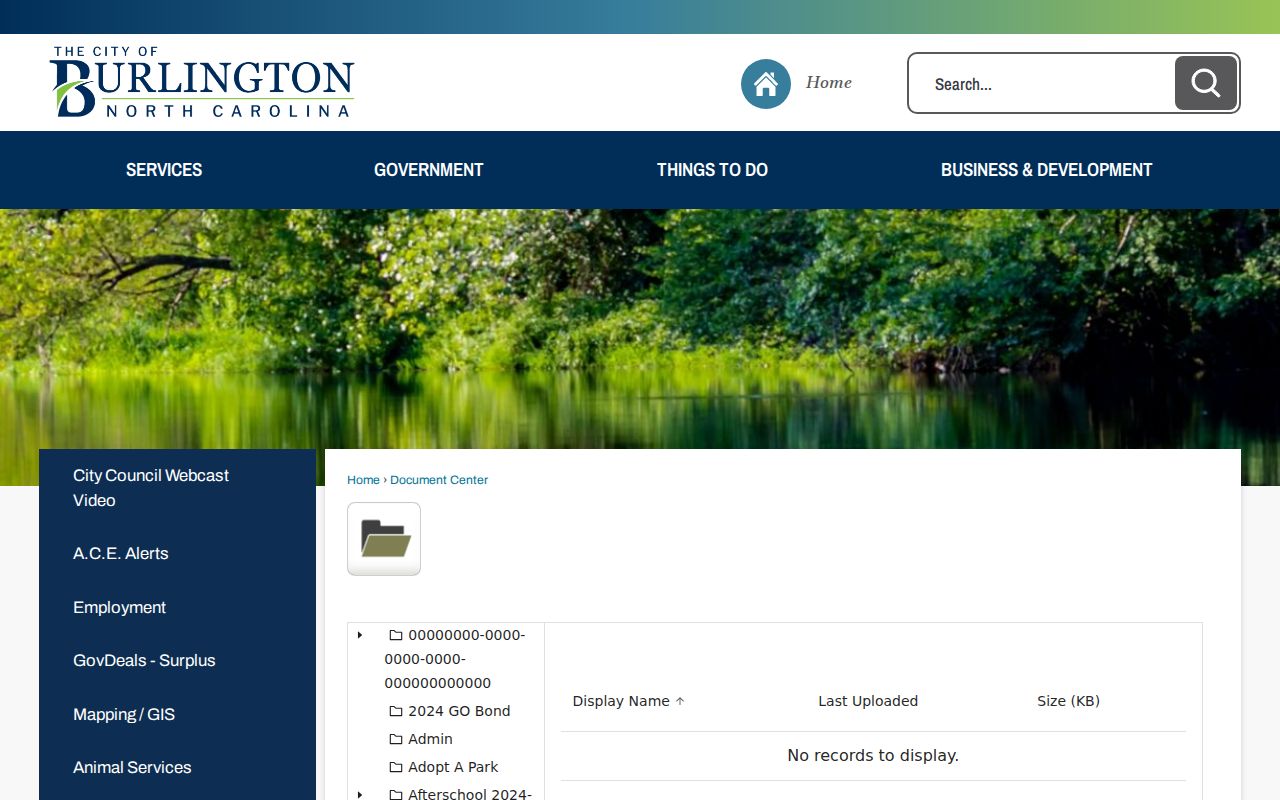
The image is a route to city forms, while the Records Section remains the source for the actual Burlington police file and any release decision.
Six Burlington Police Report Fields
A complete request gives staff enough detail to separate similar events. The Burlington form is short, but its required fields reveal the facts most useful for a search. “Person involved” is a locating field, not an invitation to request records for a prohibited screening purpose.
| Field | What to enter | Required |
|---|---|---|
| Report type | Crash, Arrest, or Other | Yes |
| Incident date | Date in month/day/year format | Yes |
| Location | Street address or clear place description | Yes |
| Person involved | First and last name | Yes |
| Email address | Requester email | Yes |
| Additional information | Report number or other locating detail | No |
If the exact report type is unclear, describe the event without guessing. Burlington staff can decide whether the responsive file is an incident, arrest, wreck, or special activity record. A narrow date and place usually do more good than a wide request for all records tied to a common name.
Booking and Arrest Records in Burlington
A Burlington arrest can create several records at once. BPD owns its incident or arrest report. For an Alamance-side arrest that reaches county intake, Alamance Detention creates the booking and custody entry. A magistrate makes the first probable-cause and release decision, and the clerk opens the state court case when process or charges enter the judicial system.
The official Alamance P2C inmate list works as a current-custody and recent-booking lead. It is not a permanent Burlington arrest archive. Its visible Burlington results include a name, primary charge, arrest date, and booking agency. A missing Burlington result may mean release, a Burlington booking in another county, a timing lag, or simply that the person is not now held. Burlington’s Guilford County reach makes the Burlington incident location especially important.
Use the dedicated Alamance County arrest search for the full county channel sequence. Keep the BPD report request at city level, since the sheriff does not become custodian of a Burlington-created report merely because county detention handled custody.
Burlington Criminal Records and Hexagon
A 2025 Burlington city-county agreement selected Hexagon for a shared computer-aided dispatch, records-management, and jail-management backbone. The Burlington agreement identifies Alamance Detention as the jail and anticipates access to county detention arrest data, county criminal history, and real-time release information among participating agencies. That technical link may help Burlington information move, but it does not merge the legal custodians.
Burlington Police still answers for the city report. Alamance Detention answers for booking and custody. The clerk answers for the criminal case. Searchers should follow that division even when staff use connected software behind the counter.
Record system: Burlington police event › Alamance booking data › North Carolina state court case.
The Burlington Municipal Court File
There is no Burlington municipal court file because North Carolina has no municipal court tier. Burlington citations and criminal charges enter the unified North Carolina General Court of Justice. On the Alamance side, District 17 matters go to the J.B. Allen Jr. Criminal Courthouse in Graham. District Court handles misdemeanors, infractions, first appearances, and early felony matters. Superior Court handles felony trials.
| Court Name | North Carolina District Court or Superior Court, not a Burlington municipal court |
|---|---|
| Case Types Heard | District Court handles misdemeanors, infractions, and preliminary felony work; Superior Court tries felonies |
| Case Lookup Channel | North Carolina eCourts Portal, courthouse public terminal, or clerk counter |
| What the Docket Shows | Case number, parties, charges, events, hearings, disposition, judgment, and financial entries when public |
| Copies & Fees | Public terminal viewing has no search fee; a certified Alamance-only name check costs $25, with copy fees separate |
For a certified Burlington case outcome from Alamance County, ask the clerk at 212 W. Elm Street, Graham, NC 27253, or call 336-570-5200. The public Portal is a useful lead, not the official court record.
Burlington Online Reports Have Limits
Burlington’s online incident reporter creates a report for a narrow set of nonemergencies. The event must be inside city limits, involve no known suspect, and not occur on an interstate or highway. Eligible categories include property damage, lost property, telephone harassment, and theft. After submission and review, the user receives a tracking number and can print a no-charge copy.
This tool does not search Burlington criminal history. It begins a new Burlington police report. A Burlington emergency, a known suspect, or an ineligible location needs another Burlington police channel. P3 Tips is a Burlington tip route, not a records database. Fix It Burlington handles civic issues and likewise does not search Burlington arrests, warrants, or police files.
How Burlington Records Reach the County
On the Alamance side, a Burlington report stays with BPD while related custody and prosecution records move through county and state offices. Fingerprints and arrest data sent through North Carolina’s criminal-information network may create or update an NCSBI Computerized Criminal History event. Later court dispositions should flow back to the repository, but delays and mismatched identifiers can leave gaps.
Record flow: Burlington Police Department › Alamance County Courts › North Carolina State Bureau of Investigation.
For a recent event, begin with police and custody sources. For a filed charge or outcome, use the North Carolina eCourts Portal and the clerk. For your own statewide fingerprint-linked North Carolina history, request an NCSBI Right to Review. That report is not a copy of every Burlington police narrative or court filing.
Burlington Body-Camera Record Rules
Body-camera video is not an ordinary police report copy. Burlington uses a separate Video Disclosure Request. The city says its camera system holds a 30-second pre-activation video-only buffer. North Carolina G.S. 132-1.4A applies a special court-controlled disclosure process to these recordings.
A person seeking a copy needs a Superior Court petition and order. Mere disclosure for viewing does not grant permission to record or copy the footage. That rule differs from a request for the basic public incident facts listed in G.S. 132-1.4. Ask for the correct product so the city can route the request under the right law.
Burlington Record Access Rules
North Carolina Public Records Law starts with broad access to records made or received in public business. Criminal information has added limits. Basic listed incident and arrest facts may be public, while investigative narratives, witness statements, confidential sources, juvenile information, victim-sensitive material, medical data, and details that could harm an active case may be withheld or redacted. Court records are open unless another law closes them.
Key Statutes:
G.S. 132-1 broadly defines public records made or received in government business.
G.S. 132-1.4 separates releasable basic police facts from protected investigative information.
G.S. 7A-109 opens clerk records to inspection unless law makes a record confidential.
G.S. 132-1.4A sets the separate disclosure and copy process for law-enforcement recordings.
Juvenile, sealed, expunged, unreturned-warrant, and protected personal information can remain unavailable. A redaction does not mean no Burlington record exists. It means the custodian applied a legal limit to the public copy.
Burlington Records Since Company Shops
Burlington began as the North Carolina Railroad repair complex called Company Shops in 1856. It incorporated in 1866 and took the Burlington name after railroad operations moved in 1886. That history helps explain the city’s growth apart from the county-seat courts in Graham. Today, Burlington Police produces city records, but criminal cases still converge in the state court system.
The downtown historic district contains 72 buildings and styles that range from Neo-Gothic to Art Moderne. Those details belong to local history, not a current record search. Modern police reports should go to BPD, and old judicial outcomes should go to the clerk or eCourts rather than a general city archive.