
Alamance County Sex Offender Checks
The official starting point is the free North Carolina Sex Offender and Public Protection Registry. The North Carolina State Bureau of Investigation maintains the statewide public system, while each county sheriff receives and verifies registrations. That split matters. The portal is best for a broad Alamance County registry search, a name search, or a distance search around an address. The Alamance County Sheriff's Office is the local source for registration appointments, verification questions, and reports of suspected noncompliance.
Gather the most reliable detail available before searching. A full name can help with a person search, but a street address may be more useful for neighborhood awareness. City and ZIP filters can narrow a long result set. A registration number is the most exact identifier when it is already known. Search results should be checked against the profile's physical description, address, offense, and status rather than matched by name alone.
The official registry search screen shows how North Carolina organizes these routes.
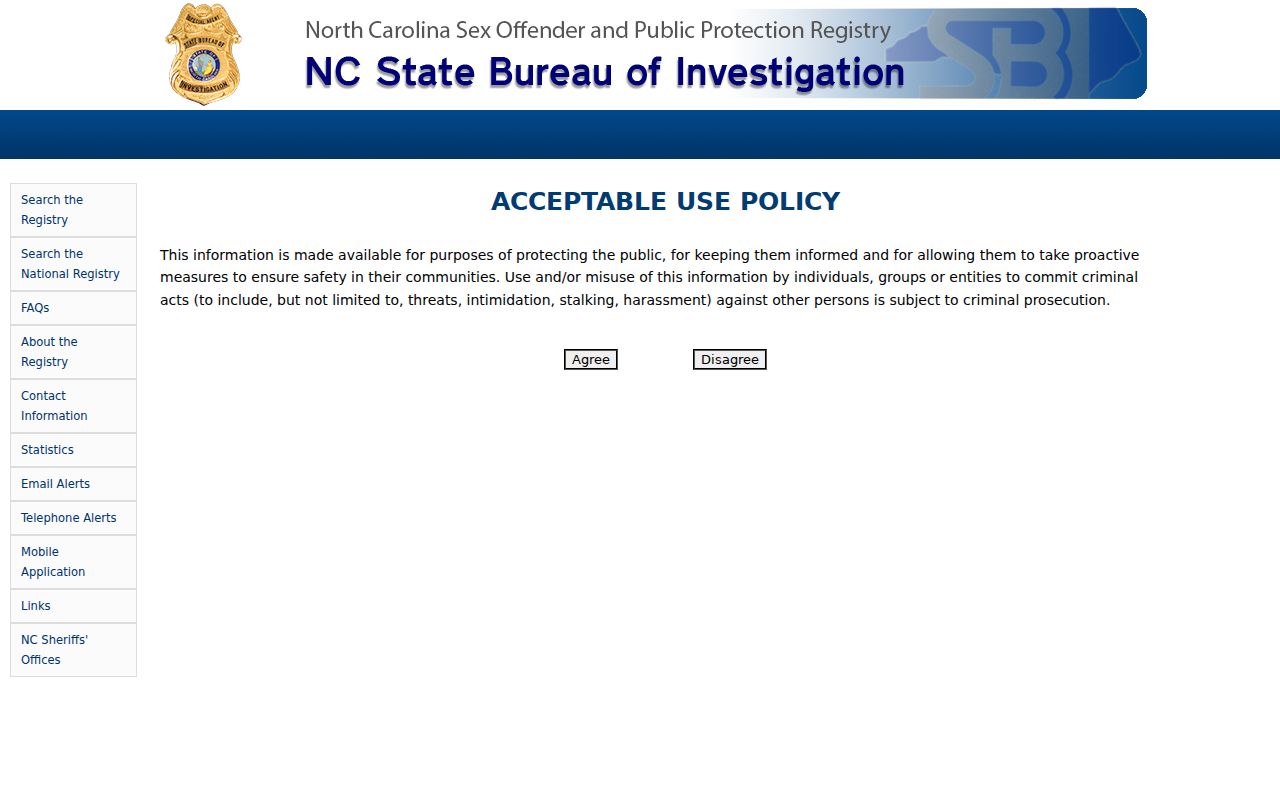
Its separate name, address, coordinate, and registration-number paths let a reader choose a search that fits the facts at hand.
Alamance Registry Verification Office
People who must register do so with the sheriff in the county where they reside. In Alamance County, that office is the Alamance County Sheriff's Office at 109 S. Maple Street in Graham. The front office is open from 8:00 a.m. to 5:00 p.m. on weekdays, and the main number is 336-228-1312. Anyone planning to appear should call first and confirm the correct desk, appointment practice, and documents needed. This office is not a substitute for the statewide public search.
The local role includes receiving registration data and carrying out the verification steps set by Article 27A. G.S. 14-208.10(b) also allows a written request to the sheriff for a county registration form or county registry, with a reasonable copying or mailing fee. That route remains available when an online search is not suitable. A concern about possible noncompliance should be reported to the sheriff's nonemergency channel, 336-570-6300. Do not confront the person named in a profile. Law enforcement can compare the report with information that is not displayed to the public.
Alamance County Sheriff's Office
109 S. Maple Street
Graham, NC 27253
336-228-1312
Weekdays, 8:00 a.m. to 5:00 p.m.
North Carolina Sex Offender and Public Protection Registry Searches
The portal opens with acceptable-use terms. Accepting them leads to several search modes rather than one general form. An address search can show registered locations within one, three, or five miles. A name search can be narrowed by city or ZIP code. Coordinate searching serves a location described by latitude and longitude, while a Sex Registration Number goes to the unique identifier route.
- Open the official registry and read, then accept, its conditions of use.
- Choose a name, address, coordinate, or Sex Registration Number search.
- Enter the best known fields and narrow the place to Alamance County when that option appears.
- Open the matching profile and compare the public identifiers, registered address, offense, and current status.
| Field or control | Type | Required | Use |
|---|---|---|---|
| Accept terms | Acknowledgment | Yes | Opens the registry tools |
| First and last name | Text | Mode dependent | Searches names and statutory cross-references |
| City, ZIP, or county | Text or select | No | Narrows the geographic result set |
| Street address and radius | Text and buttons | Address mode | Searches within 1, 3, or 5 miles |
| Latitude and longitude | Numeric text | Coordinate mode | Searches around map coordinates |
| Sex Registration Number | Text | Number mode | Uses the unique registry identifier |
North Carolina's SBI registry overview also links the search and public-alert resources.
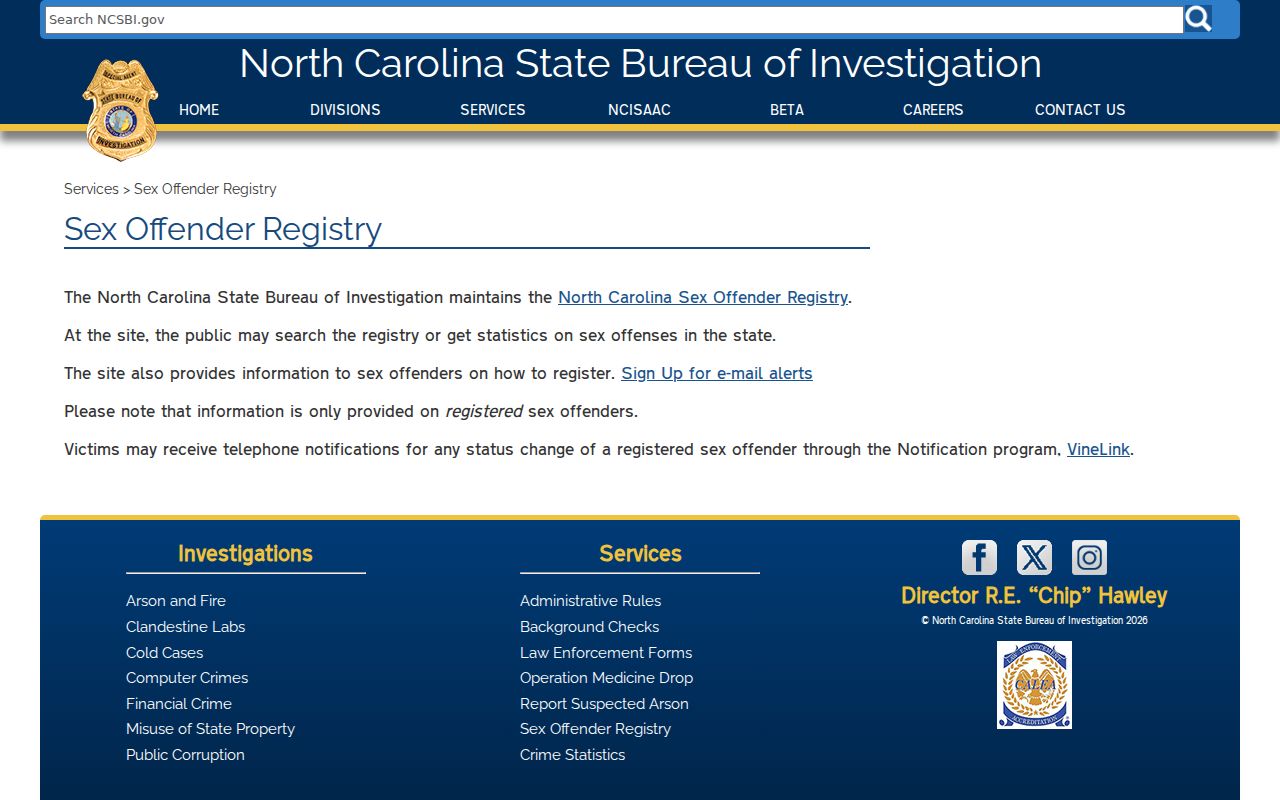
That overview helps distinguish the SBI-maintained public portal from the Alamance County sheriff's local registration work.
Alamance Registry Radius Searches
The address route is often the clearest choice for community awareness. Enter a usable North Carolina street address, then select the one-, three-, or five-mile range described in the mobile guide. Current-location GPS searching may also be available on a phone. The radius is a search boundary, not a legal buffer zone. It shows public registered addresses near the chosen point and should not be read as proof that every person outside the circle is absent from the area.
Search again after a move, a school change, or another event that alters the place of concern. The public portal can also support individual email alerts. Those notices are more useful for change monitoring than repeatedly saving an old result page. An address result still needs a profile review because similar names, nearby streets, and changes still being processed can cause confusion.
Note: A distance chosen for searching does not define North Carolina's separate statutory residence restriction.
Registry Profiles: What They Show
North Carolina law identifies the adult registry fields that may be released. A public Alamance County profile can connect a name and aliases with a physical description, current photograph, registered address, registrable conviction, sentence, and registration status. These fields support identity matching and safety planning. They do not provide a full court file or a complete criminal history.
| Name and aliases | Current name plus legal-name and alias cross-references allowed by statute |
|---|---|
| Photo and description | Current photograph, sex, and public physical descriptors used for identity matching |
| Registered address | The address reported and maintained through the county registration process |
| Offense and conviction | Registrable offense, conviction date, and sentence imposed |
| Registration category | Status and category information used to explain current duties |
| Not public | Victim identity and protected medical or treatment information |
Victim identity is never a public registry field. Medical or treatment information about a mental abnormality or personality disorder is also excluded. For the underlying conviction, filings, or judgment, the court record is the proper source. The registry answers a narrower question: whether the person is publicly registered and what information Article 27A authorizes the state to display.
Alamance Registry Count Context
The official county statistics interface displayed 340 Alamance registrants when it was inspected on August 1, 2026. That is a dated administrative count. The state itself warns that the number is approximate, may reflect processing delays or errors, and excludes pending status. It should not be treated as a fixed population measure or a crime count. One new registration, a move, a status update, or delayed processing can change it.
The registry statistics interface is the right source for a current county-level figure.
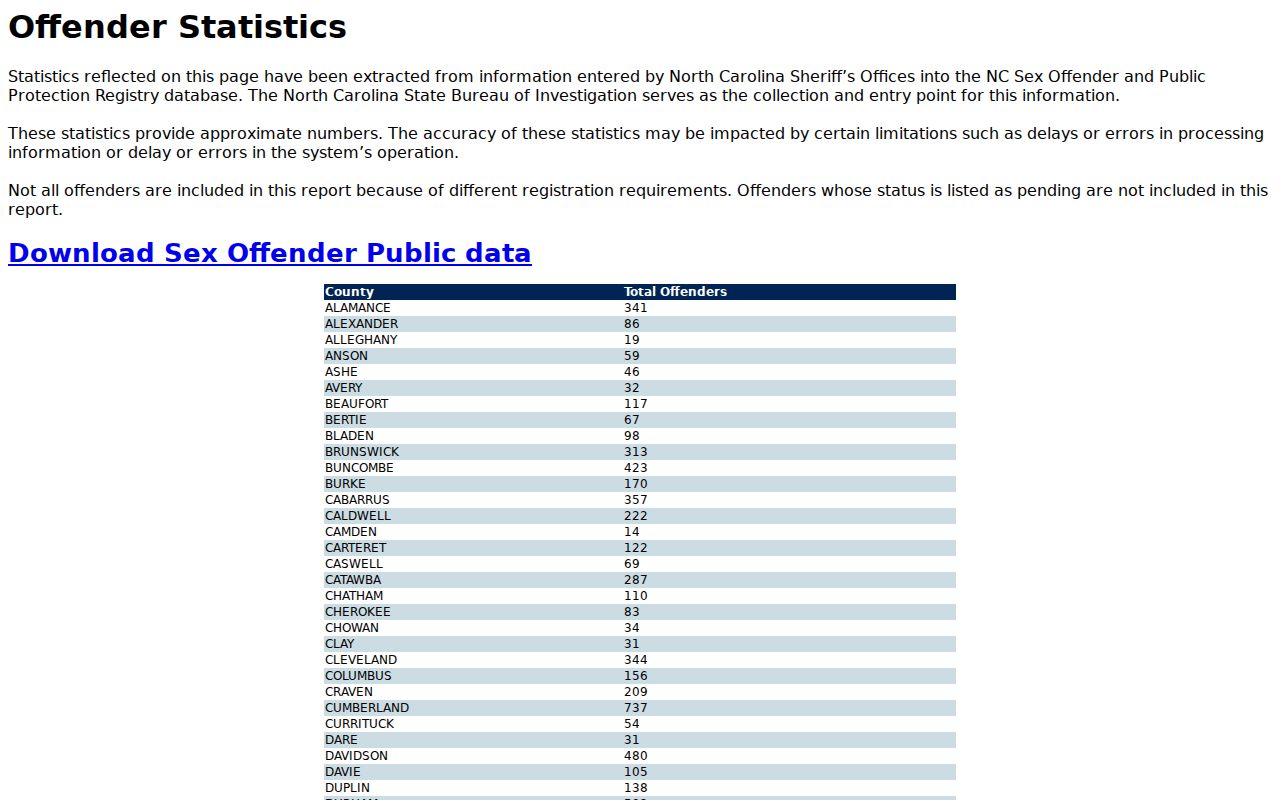
Its warnings are as important as the total because the count reflects administrative status at a moment in time.
Registration Levels and Duties in North Carolina
North Carolina's system should not be reduced to federal tier shorthand. The March 2026 SBI guidance and state Article 27A categories control the public duties. An ordinary Part 2 registrant generally has a registration period of at least 30 years from the first county registration. An eligible person may petition Superior Court after 10 years to seek early termination, but eligibility and a court decision are required. Recidivists, aggravated offenders, and sexually violent predators generally register for life.
| North Carolina category | Duration | Verification |
|---|---|---|
| Ordinary Part 2 registrant | At least 30 years; an eligible petition may be filed after 10 years | Twice yearly, with in-person return within three business days |
| Recidivist, aggravated offender, or sexually violent predator | Lifetime, generally without the ordinary termination route | Every 90 days under Part 3 |
| Juvenile adjudication registry | Ends at age 18 or the end of juvenile jurisdiction, whichever is first | Separate confidential process |
New North Carolina residents must register within three business days of establishing residence or after 15 days of presence, whichever happens first. Release from a penal institution triggers a three-business-day deadline. A person who receives no active prison term registers at conviction. Address, name, and online-identifier changes have short reporting periods. Failure to register can be a Class F felony.
The full North Carolina registration statutes set the actual categories and duties.
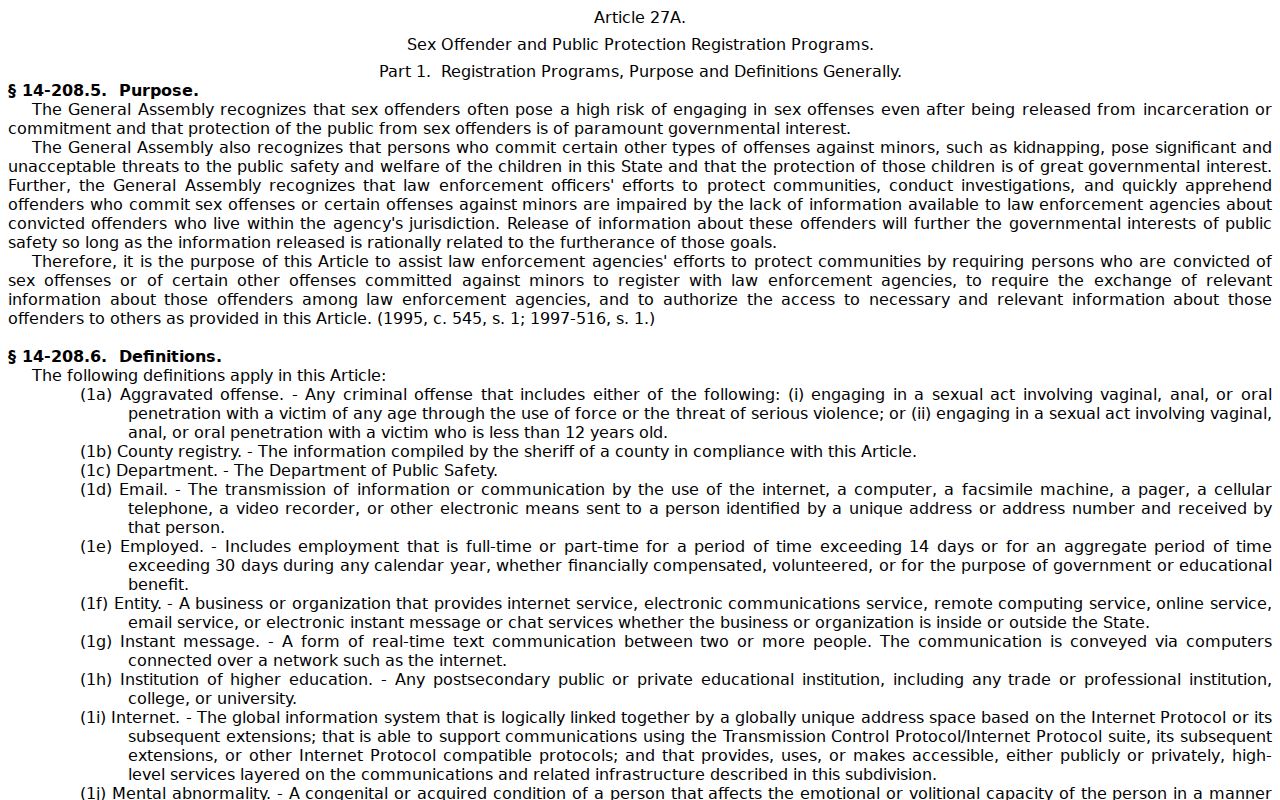
Reading Article 27A prevents a searcher from assigning a label or duty that state law does not use.
Alamance Registry Change Alerts
A one-time Alamance County search answers what the portal shows now. Alerts address later changes. The registry supports individual email alerts, and NC SAVAN offers address and compliance-change notifications at 1-877-627-2826. VINELink is the linked notification layer. Enrollment is separate from a registry search, so a person seeking ongoing notice must complete the alert process rather than assume that a saved search will update itself.
Alerts should be used as prompts to open the current official profile. They do not replace a fresh search, an Alamance County sheriff inquiry, or an emergency call. If a notice points to suspected noncompliance, report the concern to the sheriff. If there is an immediate threat, call 911. For routine verification, use the nonemergency line and give the location and public profile details without trying to investigate the person yourself.
Alamance Searches Across State Lines
The National Sex Offender Public Website provides the federal cross-state search layer. It is useful when a person may have moved, when an address is near a state boundary, or when a name search needs to cover more than North Carolina. NSOPW pulls from participating jurisdiction registries. The North Carolina portal remains the better source for state-specific search modes, local public fields, and an Alamance County filter.
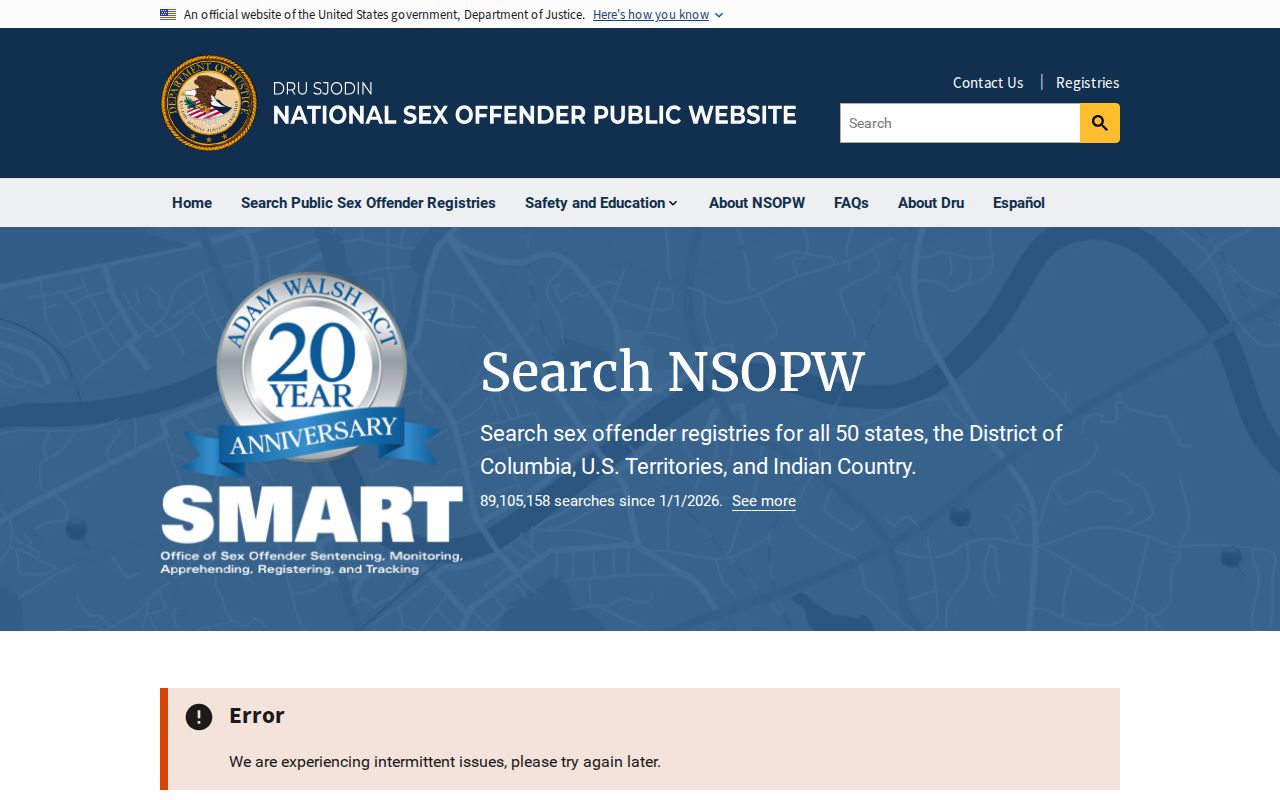
Using both layers can resolve a move across state lines without treating a national result as an Alamance County registration record.
Neither system is a substitute for identity confirmation. Compare the returned profile details and follow the link to the jurisdiction that maintains the record. If the match is uncertain, do not publish an accusation or confront anyone. The maintaining registry or sheriff can address a public-record discrepancy.
Alamance Registry Distance Rules
North Carolina G.S. 14-208.16 sets a 1,000-foot restriction involving school or child-care property for covered registrants. The phrase "covered registrants" is key. The rule should not be stated as though it applies in the same way to every person on the registry or to every type of place. The statute, the person's category, and the facts of the location control.
The search portal's one-, three-, and five-mile buttons do something different. They only define how far the map or address search reaches. A marker within a chosen radius does not by itself prove a violation, and a marker beyond it does not establish compliance with all duties. Suspected violations belong with the Alamance County Sheriff's Office, which can assess the official registration file and the statute.
The SBI fingerprint information page also illustrates that criminal-history identity work is distinct from a public registry lookup.
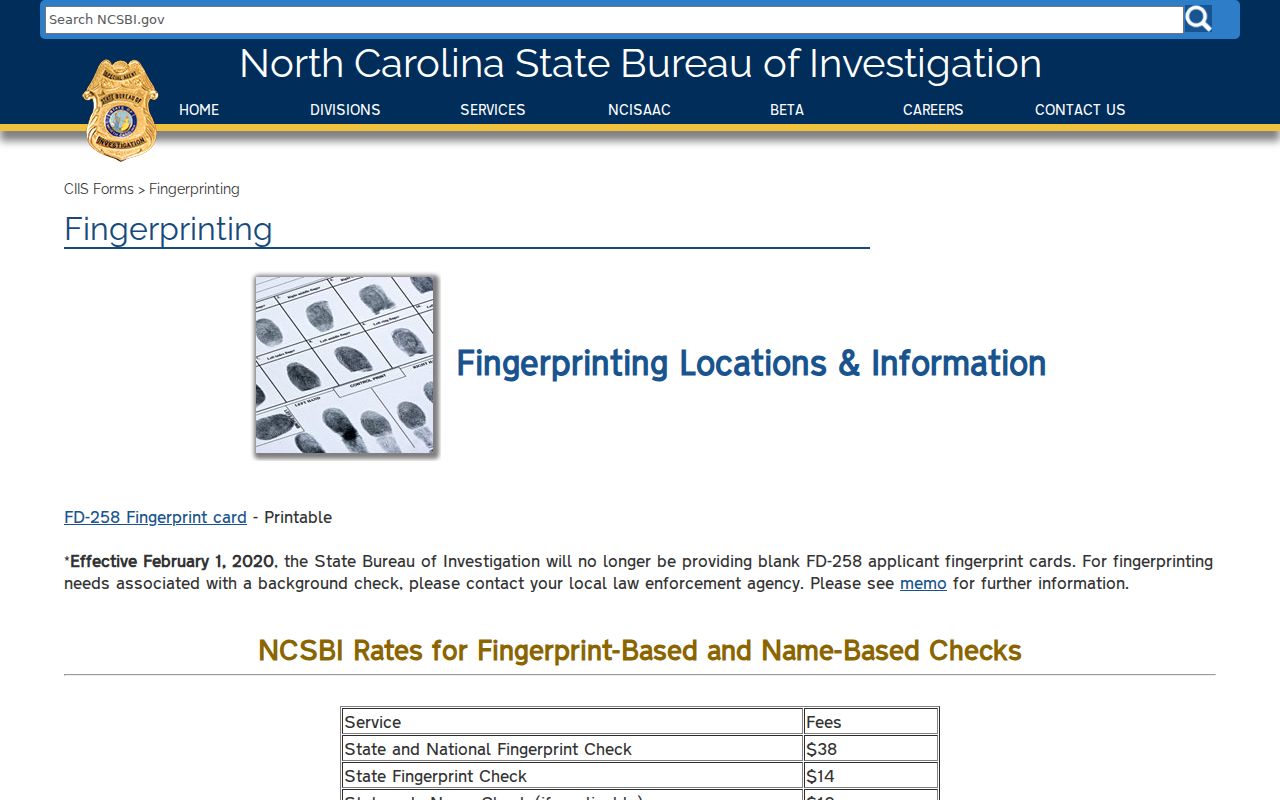
A fingerprint-based record review answers a different question from checking a publicly registered address.
Using Registry Information Lawfully
The registry exists for safety information and community awareness. Use it to understand the public record, plan sensible household precautions, and choose whether to receive official notices. The public listing does not grant power to monitor, threaten, punish, or confront a registrant or anyone in that person's household. It also does not reveal victim identity or protected treatment information.
Suspected noncompliance should go to the Alamance County Sheriff's Office. Give the office clear facts, such as the location, time, and the public profile being reviewed. Let deputies decide what must be checked. A direct confrontation risks harm, can interfere with an inquiry, and may itself violate the law.
Use the registry lawfully: Misusing registry information to harass, threaten, intimidate, or take vigilante action can be a crime under North Carolina Article 27A. Report concerns to law enforcement.